

In today’s digital-first insurance landscape, agencies cannot just rely on tools or manual workflows to keep pace with customer expectations, compliance frameworks, and competitive pressure. This is where a modern insurance agency management system becomes the operating core of every high-performing agency.
Yet, with the growing availability of insurance agency management software and a rapidly expanding ecosystem of insurance software solutions, choosing the right platform has become a strategic decision. As it directly impacts agents’ productivity, customer experience, regulatory readiness, and long-term scalability.
In this guide, we will examine the essential capabilities and evaluation criteria that insurance agencies should prioritize before investing in a management system. While features vary across vendors, the fundamentals remain consistent: a robust solution must optimize front-office workflows, empower agents, and unify the insurance lifecycle without unnecessary complexity. Now let’s see how–
Essential Evaluation Criteria in an Insurance Agency Management System (AMS)
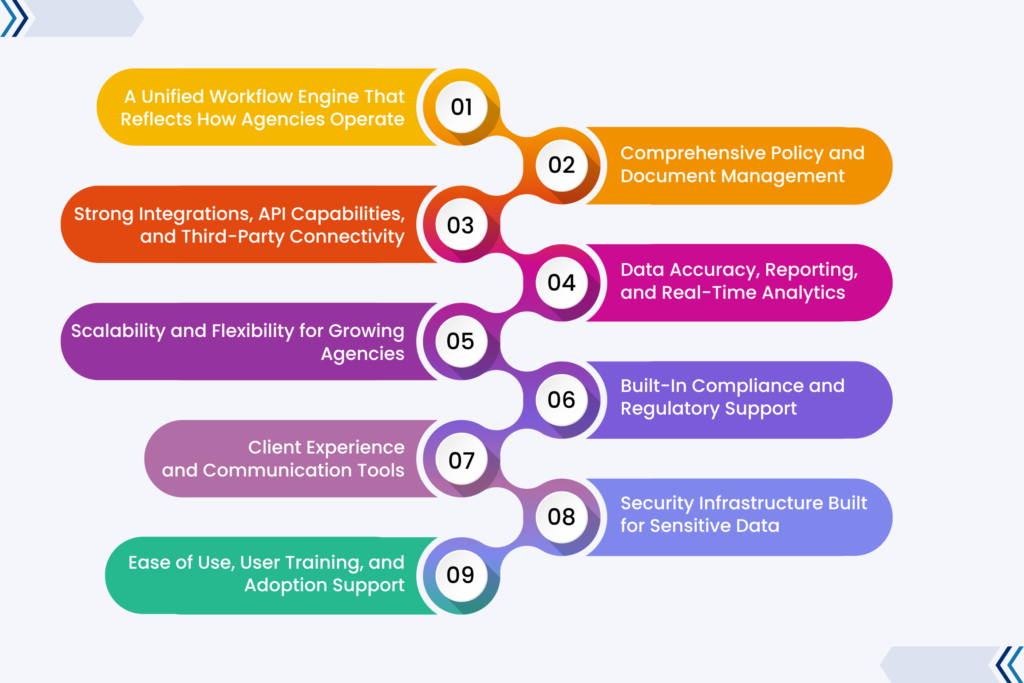
A modern insurance agency management system should deliver a core set of capabilities that directly improve operational control, efficiency, and scalability. The following features represent the non-negotiable requirements agencies must evaluate when selecting a platform.
1. A Unified Workflow Engine That Reflects How Agencies Operate
At its core, a management platform should replace the patchwork of spreadsheets, emails, task boards, and legacy CRMs that bog down daily operations. The most effective insurance agency management software introduces a consolidated workflow engine that integrates lead management, quote creation, policy administration, and renewals seamlessly.
A strong workflow system does more than automate tasks; it provides context. Every customer interaction, every policy update, every endorsement, and every compliance requirement is captured within a single environment. When evaluating insurance agency software, agencies should focus on:
- Customizable workflows that mirror the agency’s operating model
- Automated routing for submissions, tasks, and approvals
- A central timeline or activity history for every customer incident
- Policy lifecycle automation, including follow-ups and renewal triggers
Poorly stitched workflows are one of the biggest indicators of an outdated platform. Modern insurance software solutions eliminate friction by ensuring agents spend far less time navigating tools and far more time selling and advising.
2. Comprehensive Policy and Document Management
Policy servicing lies at the heart of agency operations. Any system you choose should offer advanced policy recording, document organization, version tracking, and secure storage. Without a strong policy management foundation, even the best digital insurance solution fails to support real operational efficiency.
Look for capabilities such as:
- Automated ingestion of policy documents
- Smart tagging for endorsements, certificates, and forms
- Centralized document repositories accessible across teams
- Audit trails for compliance checks
- Built-in document generation with editable templates
For agencies handling multiple carriers, lines of business, and policy structures, scalable document and policy management is non-negotiable. Insurance management software built on document intelligence not only reduces manual errors but also enhances the agency’s professionalism in clients’ eyes.
3. Strong Integrations, API Capabilities, and Third-Party Connectivity
Insurance operations today extend beyond the agency itself; agents must collaborate with carriers, Insurance Solution for Re-Insurers, MGAs, TPAs, verification services, payment gateways, and analytics tools. A platform that lacks robust integration features will quickly become a bottleneck.
Advanced insurance broker software typically provides:
- API-driven connectivity
- Integration with popular CRMs and accounting platforms
- Direct carrier connectivity (for quoting, binding, policy downloads)
- Access to third-party data enrichment, identity verification, credit scoring, geospatial data, etc.
- Support for digital payments and automated invoicing
Insurance software development has moved toward ecosystem-driven architecture. This means your chosen system must not operate in isolation. The more open and modular the platform, the better it will scale with your agency’s future technology investments.
4. Data Accuracy, Reporting, and Real-Time Analytics
Insurance agencies make decisions based on numbers: retention rates, revenue forecasts, quote-to-bind ratios, loss patterns, and customer movement across the sales funnel. A good system must present insights in a way that’s both digestible for leadership and actionable for frontline teams.
When comparing insurance agency management software, look for platforms that include:
- Real-time dashboards
- Customizable report builders
- Embedded analytics for policy performance
- Commission reporting with reconciliation
- Client segmentation tools
- Predictive indicators for renewals and cross-sell opportunities
Analytics is no longer a premium add-on; it is central to how modern agencies compete. The best insurance software turns every data point into a strategic advantage.
5. Scalability and Flexibility for Growing Agencies
he needs of an agency evolve as the business expands. A system that works for a 10-member team may become restrictive for a 200-member team. Therefore, scalability should be built into the architecture, not added as an afterthought.
Your insurance agency software should offer:
- Flexible user permissions
- Multi-branch or multi-agency support
- Configuration options for new lines of business
- The ability to incorporate external modules or custom apps
- Role-specific dashboards and workflow access
Insurance software development today emphasizes adaptability because agencies increasingly diversify, with new coverages, digital distribution channels, remote teams, and variable compliance needs.
Choosing a platform that grows with you helps avoid costly migration years down the line.
6. Built-In Compliance and Regulatory Support
Insurance is one of the most regulated industries, and agencies must maintain strict adherence to local, state, and federal requirements. The right management system automates much of the compliance burden agents typically shoulder.
Capabilities to look for include:
- Automatic recordkeeping for audit readiness
- Configurable compliance workflows for onboarding and KYC
- Secure log tracking for activity updates
- Built-in E&O protection measures, such as alerts for missing documentation
- Carrier-specific compliance prompts during policy processes
Without compliance automation, agencies increase their exposure to operational and financial risk. Insurance management software designed with compliance workflows significantly reduces this exposure while standardizing documentation practices across the team.
7. Client Experience and Communication Tools
Agencies today compete not just on pricing or coverage but on the quality of experience they deliver. Clients expect transparency, timely communication, and always-on access to their documents. As a result, modern platforms embed communication capabilities into their core architecture.
- A well-rounded insurance agency management system should include:
- Automated communication sequences for renewals, claims updates, and follow-ups
- Omni-channel messaging, email, SMS, in-app notifications
- Client portals with document access, digital forms, and policy summaries
- Tools that allow clients to request changes or initiate claims
A digital insurance solution that supports self-service dramatically reduces support load and increases customer satisfaction, two critical priorities for agencies trying to retain and expand their client base.
8. Security Infrastructure Built for Sensitive Data
Insurance agencies work with extremely sensitive customer information, financial details, identification records, health profiles, and more. Cybersecurity must therefore be a top-tier requirement.
Look for systems that provide:
- End-to-end data encryption
- Multi-factor authentication
- Role-based access controls
- Automated backups
- Compliance with data standards such as SOC 2, ISO 27001, GDPR, or IRDAI (for Indian agencies)
- Intrusion detection and monitoring
Security is not an optional feature. A breach erodes client trust and compromises regulatory standing. Choose insurance software that is built with enterprise-grade protection.
9. Ease of Use, User Training, and Adoption Support
A tool is only valid if your teams can operate it comfortably. Complex or unintuitive interfaces slow adoption and create internal resistance. Agencies should assess:
- The quality of UI/UX
- Availability of onboarding support and training sessions
- Quality of documentation and help centers
- Responsiveness of customer support teams
- Frequency of updates reflecting user feedback
User experience is often overlooked during evaluation, yet it plays a significant role in operational efficiency.
Takeaway
Selecting the right insurance agency management software is ultimately about finding a system that aligns with your agency’s structure, accelerates daily operations, strengthens compliance, and elevates client service. With so many insurance software options available, agencies must evaluate platforms not just on functionality but on their ability to create scalable, integrated, data-driven environments.
A well-chosen insurance software solution becomes more than a tool; it becomes the backbone of a digitally empowered insurance operation. Whether you are adopting technology for the first time or replacing legacy systems, focusing on integration, analytics, security, compliance, and user experience will guide you toward a platform that supports growth for years to come. Ensurite embodies these principles by offering a modern, adaptable ecosystem that helps agencies operate with greater clarity and precision.
For teams looking to strengthen their digital foundation, Ensurite offers a forward-ready platform that can evolve with the changing insurance landscape. To know how we help Insurtechs with an efficient management setup, or how we can help you build the same, connect with our experts now!
Explore more Blogs: https://ensurite.ai/blog/
Frequently Asked Questions:
How does an agency management system improve operational efficiency?
By consolidating customer records, policy data, communications, and workflows into a single environment, an agency management system eliminates redundant tasks and manual data entry. Automation triggers reduce follow-up gaps, integrated document handling speeds servicing, and centralized analytics enhance decision-making. Agents spend less time navigating tools and more time advising clients, resulting in faster service cycles and higher productivity.
How important is automation in an agency management platform?
Automation is critical. It ensures accuracy, consistency, and speed across policy administration, renewals, reminders, documentation, compliance checks, and reporting. Automated workflows reduce human error, improve turnaround time, and free up agents from repetitive administrative work. For agencies aiming to scale, automation becomes the foundation for predictable, efficient operations.
What integrations are essential for a modern insurance management system?
A modern platform should integrate with carrier systems for quoting and policy downloads, CRM platforms for sales alignment, accounting tools for billing and reconciliation, payment gateways, e-signature solutions, customer communication tools, identity verification services, and analytics platforms. API-driven connectivity ensures the system can work seamlessly across the agency’s broader technology stack.
How do I choose the right agency management system for my business needs?
Start by assessing your workflow gaps, policy volume, team size, and growth plans. Prioritize systems that offer configurable workflows, strong automation, secure data handling, carrier connectivity, and clear reporting capabilities. Evaluate UI/UX simplicity, customer support quality, scalability, and vendor reliability. A pilot or demo phase with real use cases helps validate whether the system aligns with your operational structure and long-term digital strategy.